This year, the National Afterschool Association Conference convened in Washington, D.C., uniting afterschool and out-of-school-time (OST) professionals from across the nation. In partnership with the Afterschool Alliance, the conference provided OST leaders with a critical opportunity: to bring the stories of their programs directly to the halls of Congress.
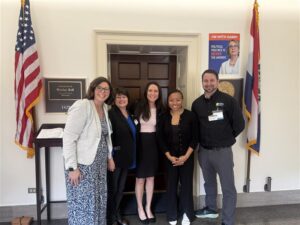 Representing the Missouri AfterSchool Network (MASN), a dedicated team traveled to Washington to give voice to Missouri’s youth, working families, and communities. The delegation included Cassie Hackett, MASN Policy Support Specialist, Missouri Afterschool Ambassador Erin Malone of Mission St. Louis, and program coordinators Traci Critser of Hollister Tiger Academy and Tyler Kearns of Clayton Kid Zone, who also serves as Chair of MASN’s Afterschool Leadership Team.
Their mission was grounded in a fundamental truth: lawmakers cannot champion what they do not understand. The delegation advocated for sustained investment in initiatives such as the 21st Century Community Learning Centers grants and other funding mechanisms that enable programs to expand their reach and serve more youth across the state—but equally important was ensuring Missouri’s congressional representatives could hear, firsthand, why that investment matters.
The team met with Destiny Jones, Legislative Assistant for Congressman Wesley Bell, representing Missouri’s 1st Congressional District. They also followed up with staff from Senator Hawley’s and Representative Alford’s offices in preparation for an additional Missouri afterschool legislative visit planned for June.
In each conversation, the team did more than present data—they shared stories. They described how afterschool programs advance academic achievement, provide safe environments for youth, create meaningful opportunities for families, and build stronger communities. They also conveyed the broader economic significance of afterschool and OST programs: supporting working parents, generating local employment, and inspiring the next generation of program leaders.
As Tyler Kearns reflects, “No matter the size or structure of our programs, every afterschool professional has a story that proves the impact of this work. When we share those stories with leaders, we remind them that investing in afterschool isn’t just funding a program—it’s investing in the future of our communities.” The response affirmed what the team already knew—when advocates show up with real stories, legislators take notice.
This experience reinforced a powerful reality: every program—whether large or small, grant-funded or fee-based—has a story worth telling. Afterschool professionals across Missouri are not only shaping opportunities for young people; they are the most compelling advocates for the work itself.
Continued advocacy efforts like these ensure that the voices of students, families, and OST professionals reach the highest levels of government. By showing up, sharing stories, and championing the value of afterschool programming, Missouri’s afterschool and OST community is making the case that investing in these programs is, fundamentally, an investment in the future.