Program directors and afterschool administrators from across Missouri and Kansas gathered at the Kauffman Foundation Conference Center in Kansas City for the 2nd annual Afterschool Leadership Conference (ALC), a two-day professional development event organized for those who lead afterschool programs. The conference focused on practical strategies, peer collaboration, and tools that participants could apply immediately upon returning to their programs.
ALC is designed around a focused purpose: connect afterschool leaders with actionable strategies and with colleagues who understand the demands of the work. For many who attended, that dual function — professional learning alongside genuine peer connection — set the conference apart from typical training events.
“It was great to have a space specifically for administration staff to go and get out of the weeds of programming a bit to see and connect through bigger picture topics.”
— Courtney Carpenter, Ozarks Regional YMCA, Springfield
That sense of shared purpose carried through both days of the conference.
“Usually at a conference you’re trying to find your people. Here, everyone felt like my people because we’re all doing the same work.”
— 2026 ALC Attendee
Culture Starts at the Top
Keynote speaker Marissa Badgley opened the conference with a session examining program culture and the direct role leaders plays in shaping program climate. Her central message — that effective leaders must function as a thermostat rather than a thermometer — challenged participants to move beyond simply reading the “weather” of their programs and toward actively creating it.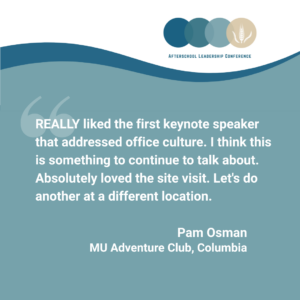
Badgley framed culture not as a byproduct of circumstance, but as something leaders build through deliberate, consistent action. A blueprint activity gave participants structured time to examine the culture they want to create in their programs and to identify the specific steps required to get there.
Building Partnerships That Last
Brandis Stockman of the National League of Cities led a session focused on community engagement, making the case that the strongest afterschool programs are not simply located in communities — they are woven into them. The goal Stockman set before participants was to build connections so essential that families, local partners, and civic leaders would fight to preserve their programs. Belonging and long-term durability, she argued, matter more than visibility alone.
For attendees from smaller communities, the session surfaced practical ideas about where to look for partnerships when the available pool is limited.
“I networked with several other small-town afterschool directors and evaluators who were able to give me some fantastic ideas for partnerships in an already widely used, small pool of opportunities.”
— Mindy Jarrett, Woodland R-IV School District, Marble Hill
Making the Case for Afterschool Funding
Eric Peterson of the Afterschool Alliance opened the second day with a session on the current state of afterschool funding and the growing importance of advocacy at every level of 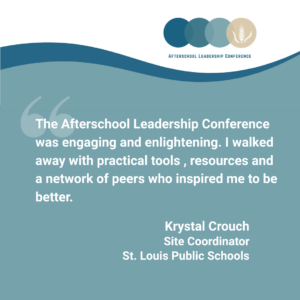 government. Eric outlined why program leaders — not just association staff or lobbyists — are among the most credible and effective voices for afterschool investment. Providing attendees tools to begin making that case in their own communities.
The session prompted immediate follow-through from several participants.
“I am taking away the importance to advocate, advocate, advocate!! Building partnerships where there is a benefit for both afterschool youth and partnering organizations is crucial in building long-standing commitments and relationships.”
— Kaitlin Bullmaster, InterServ, St. Joseph
“I have already contacted our mayor to visit. The staff agreed it would be nice to have parents come in one evening a month..”
— Nancy Burtch, North Missouri Center for Youth and Families, Chillicothe
Breakouts Address Day-to-Day Leadership Challenges
The second day also featured breakout sessions organized around the practical realities program leaders navigate regularly. Participants selected from sessions on behavior management, HR and staff on-boarding, summer learning, advocacy, creating safe spaces, and managing staff across different generations and age groups. The smaller format allowed for more direct conversation and peer exchange than larger plenary sessions typically permit.
“This was my first ALC. I loved the small group feel and felt that the topics were all relevant to me as the program and financial director at my district. I walked away knowing more than when I walked in, and networked with some wonderful people who face the same things I do daily.”
— Mindy Jarrett, Woodland R-IV School District, Marble Hill
Activities Built for Immediate Use
A defining feature of ALC is its emphasis on tools participants can use going forward. This year, facilitators shared a set of connection activities designed for staff teams that can also be adapted for student programming. The Eclipse Game, a movement-based activity, focuses on quick thinking and group interaction. Two-Minute Teach pairs participants and prompts them to teach each other something they know within two minutes. A divergent thinking exercise challenges participants to fill a 30-square grid with ideas generated from a single word or prompt. Each was offered as a low-prep, high-impact option for program leaders looking to strengthen team culture or student engagement.
“So great to connect with colleagues, share knowledge and experience along the way – receiving confirmation and validation in what we do. ALC is truly a one stop shop.”
— Pam Osman, MU Adventure Club, Columbia
Pitch Challenge Puts Leadership Skills to the Test
The conference also included a pitch challenge in which participants worked in small groups to develop and present a recorded afterschool pitch. Groups chose between two categories — product or service — and competed for recognition and prizes.
Product Winner: DNA-Detect. Name. Assign: The future of lost and found pitched by Esmeralda Ortiz, Monserrat Gallardo, and Tony Coronado, Guadalupe Centers
Service Winner: Thrive After Three: A professional youth service staffing agency pitched by Stephanie Seals, Better Family Life, and Philece Horton, Unleashing Potential
The exercise was designed to give leaders direct experience with the same process they ask students to complete in youth entrepreneurship competitions. By going through the challenge themselves, participants are better equipped to instruct their staff how to prepare young people for opportunities such as the Young Entrepreneur Institute’s Out-of-School Time Pitch Contest, MASN’s Youth Entrepreneurship Pitch Challenge, and the Mott Million Dollar Pitch Challenge.
A Renewed Commitment to Intentional Leadership
Across two days of keynotes, breakouts, and peer exchanges, ALC 2026 returned consistently to a single premise: strong afterschool programs do not happen by accident. They are built through deliberate culture-setting, deep community investment, and staff practices that consistently put young people first.
Program leaders left with new strategies, renewed relationships, and a clearer sense of direction. When leaders take ownership of the conditions they create, they build the foundation for programs that serve staff and students well — and the afterschool programs their communities will work to sustain.


